Starring: Jeff Bridges, John Goodman
Written and Directed By: Joel and Ethan Coen
* * (out of 4)
I count myself as a fan of the Coen Brothers films. I like their writing, I like their characters, I like their visual style. They have made some crazy ideas for films somehow work.
By the time the Coen Brothers made “The Big Lebowski” in 1998, they already had 6 films to their credit, having most recently made what is still their best film, “Fargo”. They had enough success, and built up enough goodwill with their audiences that they could get away with some things that other filmmakers couldn’t.
I fear that the usually reliable Coen Brothers got too caught up in that  creative and artistic free license when they made “The Big Lebowski.” It is a somewhat polarizing film that has the familiar quirkiness of previous Coen Brothers films, but relies far too heavily on style over substance. It is often a very funny movie, but it never begins to make any sense, or have any meaning. It’s a very strang movie, and you either buy into it, and enjoy it for its zaniness, or you don’t. I bought into it, at least for its story and its characters, but I didn’t quite get the zaniness. I think the film is an exercise in pure style, and that just didn’t work.
Jeff “The Dude” Lebowski (Bridges) comes home to find two thugs waiting for him and saying his wife owes them money, and one of them urinates on The Dude’s rug, (which disappoints him because the rug “really pulled the room together.”) They quickly realize they’ve got the wrong Lebowski, and leave. The Dude goes looking for the other Jeff Lebowki (David Huddleston), hoping to get compensated for his soiled rug. Later, when the other Lebowski’s trophy wife is kidnapped, The Dude is recruited as an intermediary to negotiate her safe return.
The Dude’s also an avid bowler, and spends a lot of time down at the bowling alley with Walter(Goodman), a grizzled Vietnam vet who advises on what to do about his current problem, and Donnie (Steve Buscemi), a timid little shrimp who can hardly get three words out without being told by Walter to shut up.
The character of The Dude is an interesting study. I can buy into the idea of him, and Jeff Bridges plays it perfectly. He is a idol for many fans of this film, though whether its his philosophy or his lifestyle or both is unclear to me. I suppose I can understand the appeal of The Dude, but I think what it comes down to is that his life is not mine, it is not one that I aspire to, and while a character like that may be fine as a supporting role, I find it difficult to stick with him for 2 hours.
This was my second viewing of “The Big Lebowski,” and I think I liked it less than the first time I watched it, and I didn’t overly enjoy that time either. I have really tried to like this film, but keep coming back to the same thing–this film is an experiment in pure style. I enjoy the Coen Brothers style, but what made their previous films work was some substance that makes the film worth watching. I have yet to find that in this film.
The Coen Brothers can do so much better than this. “The Big Lebowski” feels like a wannabe ripoff of what has made their previous films work. It’s sort of like a weird crossing of “Raising Arizona” and “Fargo”. They got the style right, but never do anything interesting with it.


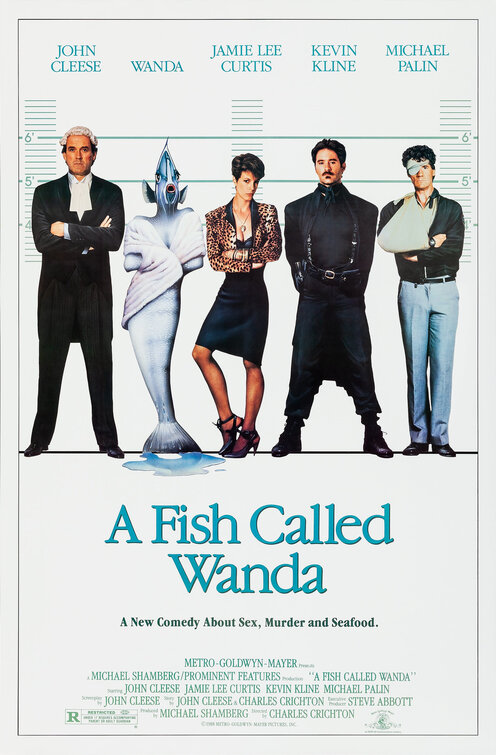 Americans, Wanda(Jamie Lee Curtis) and her lover Otto (who poses as her brother) to help. The theft goes well, and they diamonds are hid safely away. Both George and the two Americans want the loot for themselves, so Wanda and Otto (Kevin Kline) have George arrested. George, of course, has already hidden away the diamonds before he is sent to jail. So, a mad chase begins.
 fascinating films ever made. As for it being the greatest film ever made? It’s hard to argue with it, and it keeps me coming back for repeated viewings once or twice a year, so it’s doing something right.
 captivating film. Taking place virtually in real time, the film is a wonderful case study of personal prejudices, perspectives, and backgrounds and the way they cloud our judgment.
 in his simple goal, to be on the Jerry Langford’s (Jerry Lewis) show, which he thinks will launch his comedy career. At the same time, he takes obsession to a whole new level, and that got on my nerves a little. But I never grew to hate him. He is utterly likeable and charming, which is both a strength and weakness. It makes what he does acceptable and understandable, but we never truly feel any sort of threat from him. That at least keeps the film grounded comedically, but prevents it from being even greater.
 with his girlfriend, Robin(Leslie Mann) by prematurely proposing marriage. He moves into a new apartment, and waits all day for the cable guy to show up. When he finally does, Steve takes his friends’(Jack Black) advice and tries to bribe the cable guy to get free movie channels. The cable guy takes an instant liking to Steve, and wants to be friends. Steve reluctantly (and stupidly) accepts. He soon regrets it, because Chip never leaves him alone, and basically stalks him. He gives Steve a complete entertainment system upgrade. And Chip, inexplicably, insists on trying to help get Steve back together with Robin.
 his day off. His best friend, Radnall (Anderson) works in the video rental store next door (though “works” might not be the right word, since he spends most of his time with Dante in the Quick Stop.) It’s a day in the life story as Dante deals with annoying customers, trying to fit a street hockey game into his work day, finding out some distrubing news about his current girlfriend, and learning about his old flame’s recent engagement announcement.
 enjoyed the film, and in the long run, I didn’t enjoy this film. It’s obviously a very good film, but I just couldn’t get into it. The problem is in my basic ignorance of and apathy towards 18th century France, where this film is set. But, that’s a fault with me, rather than the film. Save for its adaptation of the original story (and stage play), and in turn, the expectations of women in society in 18th century France, (and it’s relation to portions of the story), there is not a single reason for this film to be set in the 18th century. I kept feeling that it could have easily been modernized, even keeping much of the material nearly the same, and it would have kept my interest, and not lost any of the film’s intended impact. Again, that’s a me problem, not a fault of the film.
 all found strangled with a necktie. We find out early on who is the innocent man, and who the killer is. The rest is the circumstances of how one comes to be suspected, and how the other carefully manages to avoid suspicion.

